When the Dividend Arrives as Shares: A UK Income Investor’s Scrip Decision Guide
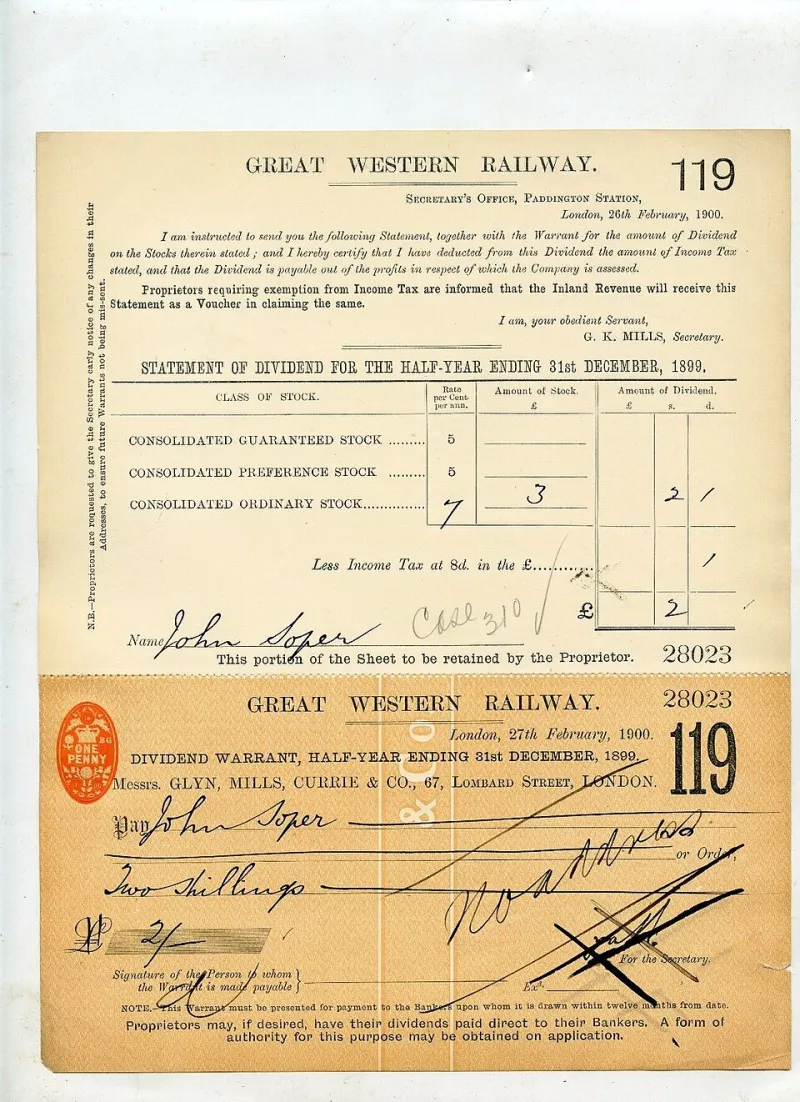
Photo: Great Western Railway, Public domain, via Wikimedia Commons
A scrip dividend gives shareholders the option to receive new shares instead of cash. For companies, it preserves cash while maintaining a dividend record. For investors, it offers automatic reinvestment without a separate dealing instruction. In 2026, with UK income investors balancing spending needs against long-term compounding, scrip is worth understanding properly. The shares are not a bonus. They are a distribution in a different form, and the decision should be made on total return, tax and portfolio fit rather than on the appeal of receiving something that looks free.
Why companies offer scrip
Companies offer scrip for several reasons. Retaining cash can support capital expenditure, reduce borrowing or strengthen a balance sheet without cutting the dividend. For banks and insurers, scrip can also help protect regulatory capital. For investment trusts and property companies, it can be a way to retain capital while keeping the distribution policy intact.
The mechanism is usually straightforward. Shareholders elect to receive shares, often by a specified deadline, and the company issues new shares at a reference price based on the market. Some companies offer an enhanced scrip dividend, where the value of the shares is slightly higher than the cash alternative. Others default to cash unless the shareholder opts in.
Scrip sits between a cash dividend and a buyback. A cash dividend distributes money and reduces the company’s cash reserves. A buyback uses cash to reduce the number of shares in issue, which can lift earnings per share and return capital to selling shareholders. Scrip preserves cash but increases the number of shares in issue. That is the key trade-off: existing shareholders are not diluted if they take shares, but the company’s earnings are spread over a larger share count.
The tax point that changes the decision
For UK taxpayers, a scrip dividend is generally treated as a dividend for income tax purposes, valued at the cash alternative. That means it can use the dividend allowance and be subject to dividend tax rates, even though no cash arrives. In an ISA or SIPP, the tax wrapper normally neutralises the income tax charge. Outside a wrapper, the investor may owe tax on a distribution that produced no cash to pay it.
Record-keeping matters for capital gains tax. The new shares usually acquire a base cost for CGT purposes based on their market value when issued. Investors should keep the dividend statement and the share issue details. Enhanced scrip dividends can have different treatment, so the company’s tax guidance and professional advice should be checked before relying on a general rule.
There is also a practical point about fractions. Scrip plans often produce fractional entitlements, which may be rounded down, carried forward or settled in cash. The value is usually small, but it is not zero. Administrative charges for selling fractions can matter in a small holding.
A decision framework for income investors
1. Start with cash need. If the investor needs the dividend to fund spending, scrip creates a two-step process: receive shares, then sell. That may incur dealing charges and expose the investor to price movement between the issue date and the sale. For a genuine income portfolio, the cash dividend is often the cleaner choice.
2. Test the company’s use of cash. If the retained cash is funding projects with attractive returns, scrip can be a sensible way to compound. If the cash is simply sitting on the balance sheet or plugging a shortfall, the scrip may defer a distribution without creating value. The question is not whether the company offers scrip, but what it does with the money it keeps.
3. Check concentration. Automatic reinvestment increases exposure to the same company. An investor who already holds a large position may prefer cash to diversify elsewhere. Scrip is most useful when the position is modest and the investor wants to build it steadily.
4. Compare tax wrappers. In an ISA or SIPP, scrip can be administratively efficient because there is no immediate income tax charge. In a general investment account, the investor needs to plan for the tax bill and keep records. The wrapper can change the answer more than the dividend policy does.
5. Compare the alternatives. A cash dividend can be reinvested manually, but that may cost a dealing fee. A buyback may be more tax-efficient for some shareholders, depending on their circumstances, but it is a company decision rather than an investor election. Scrip is a hybrid: taxed like income, delivered as equity. It should be judged against both cash and buyback outcomes.
6. Read the small print. Election deadlines, default elections, enhanced scrip terms and fractional arrangements vary. A shareholder who does nothing may receive cash by default, or may be deemed to have elected shares. The default is part of the decision.
A worked illustration
Consider a £10,000 holding paying a 5% dividend. The cash dividend is £500. The scrip alternative is roughly £500 of new shares, subject to the reference price and rounding. If the investor needs £500 to spend, taking shares and selling them may incur a dealing charge and price risk. In a general investment account, with the dividend allowance already used, a higher-rate taxpayer could face £168.75 of dividend tax on £500 at 33.75%, whether the distribution is cash or shares. In an ISA, that charge does not arise. The scrip has not created an extra £500 of value; it has changed the form of the distribution.
When the ‘free shares’ are not free
Scrip shares are not free for three reasons. First, they are taxable income in a general account, even without cash. Second, they increase the share count, so the company’s earnings are spread more widely unless the retained cash earns an adequate return. Third, they add concentration and administrative burden. The investor may also lose the flexibility that cash provides.
None of this makes scrip inherently bad. For a long-term investor in a tax wrapper, with a modest position and a company that retains cash productively, scrip can be a low-friction way to compound income. For an investor who needs cash, holds a concentrated position or invests outside a wrapper without tax headroom, the cash dividend may be the better choice.
The practical conclusion for 2026 is to treat scrip as an active decision rather than a default. Read the terms, check the tax wrapper, assess the company’s use of retained cash and compare the outcome with cash and buyback alternatives. The dividend may arrive as shares, but the discipline required is the same as with any other income decision.