The 4:30 Fix: Reading London's Closing Auction as an Execution Decision
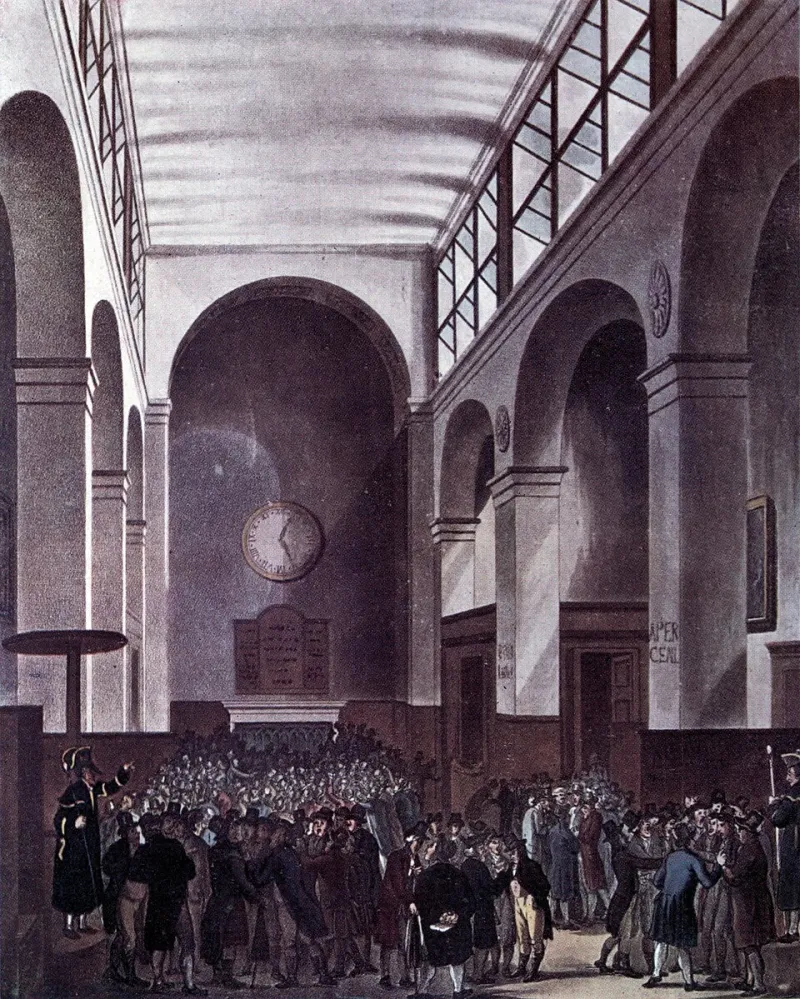
Photo: Thomas Rowlandson (1756–1827) and Augustus Charles Pugin (1762–1832) (after) John Bluck (fl. 1791–1819), Joseph Constantine Stadler (fl. 1780–1812), Thomas Sutherland (1785–1838), J. Hill, and Harraden (aquatint engravers)[1], Public domain, via Wi
For most UK equity investors, the trade plan begins and ends with what to buy or sell. The question of when is often left to the broker's default. That is a mistake, particularly in London, where the closing auction has become a significant execution venue rather than an administrative afterthought. The price struck at the end of the trading day is the official closing price, but it is not a price that arrives without risk. It is a clearing price formed by the orders that enter a short, concentrated window.
Why the close attracts so much flow
The London Stock Exchange's closing auction exists to pool liquidity at a single reference point. That reference point matters enormously to passive funds, exchange traded funds and index trackers, which typically seek the official closing price to minimise tracking difference against their benchmark. On FTSE index review dates, the attraction is even stronger: funds that must adjust holdings to a changed index weight have a natural incentive to transact at the close, because that is the price against which their performance will be measured.
Retail flow follows the same logic. Many UK brokers offer an at-close or market-on-close instruction, and it can appear cheaper than a continuous-session trade because the commission may be lower and the instruction is simple. The simplicity is real. So is the concentration of flow. What looks like a deep pool at 4:30pm is often a narrow window in which a large volume of buyers and sellers meet at one price. The volume printed there is not continuously available. It is the result of an auction.
The market-on-close illusion
A market-on-close order promises execution at the closing price. It does not promise that the closing price will resemble the last traded price seen minutes earlier. In the continuous session, an investor can see a quote, place a limit and retain control over the worst price accepted. In the auction, the investor accepts the clearing price that the order book produces.
That distinction matters most when the auction is unbalanced. If a large surplus of sell orders meets insufficient demand, the closing price can settle below the last continuous trade. If buy orders dominate, it can settle above. The investor who chose the close because it looked cheap may find that the price paid more than offsets any commission saving. The official close is a reference price, not a bargain.
UK investors should also check what their broker actually offers. An at-close instruction may be a genuine auction order, or it may be routed differently. Some brokers provide a limit-on-close facility, which allows the investor to specify a worst price; others do not. The difference is not cosmetic. It determines whether the investor has any protection against an adverse auction print.
Reading the imbalance without overreading it
Auction imbalances are published in some form during the closing window, showing whether buy or sell interest is surplus at the indicative price. For an investor, the information is useful context but a poor forecast. A buy imbalance does not mean the shares are undervalued. It means that, at that moment, demand at the indicative price exceeds supply. Participants can enter or withdraw before the uncrossing, and the final price can differ from the indicative price.
On index review days, imbalances can be mechanical rather than informational. A fund that must buy a stock to match a new index weight will create demand regardless of its view on value. The investor who reads that imbalance as a signal about the company's prospects is misreading the plumbing. The more disciplined approach is to treat the imbalance as a measure of execution pressure, not as an investment verdict.
When an earlier trade is the better choice
There are clear cases in which the continuous session deserves priority. If price certainty matters, a limit order earlier in the day gives the investor control that the auction cannot. If the stock is thinly traded, the closing auction may not be the deep pool it appears; for smaller UK companies, the auction can be less liquid than the headline volume suggests. If results, a trading update or a takeover announcement is due, the auction price can absorb the news in a single print, leaving the investor with no chance to react.
The auction can still be the right venue. A large order that would dominate the continuous order book may benefit from the pooling effect of the close, and an investor whose objective is to match the official closing price has a legitimate reason to use it. The decision should rest on the objective, not on the apparent cheapness of the instruction.
A practical checklist before using the close
First, define the objective. Is the aim price certainty, benchmark matching or simply lower commission? Second, confirm the order type with the broker and understand whether a limit is available. Third, review the stock's typical auction volume and spread rather than assuming the close is always liquid. Fourth, avoid last-minute changes to an auction order; the window is short and the final price is not negotiable. Fifth, record the execution price against both the arrival price and the official close, so that the next trade plan is informed by evidence rather than impression.
The closing auction is a legitimate part of the London market, and for some investors it is the correct tool. But it is an execution venue with its own rules, not a discount window. The 4:30 fix should be chosen with the same discipline as any other trade.